Best Live Aquarium Plants for Beginners (2027)
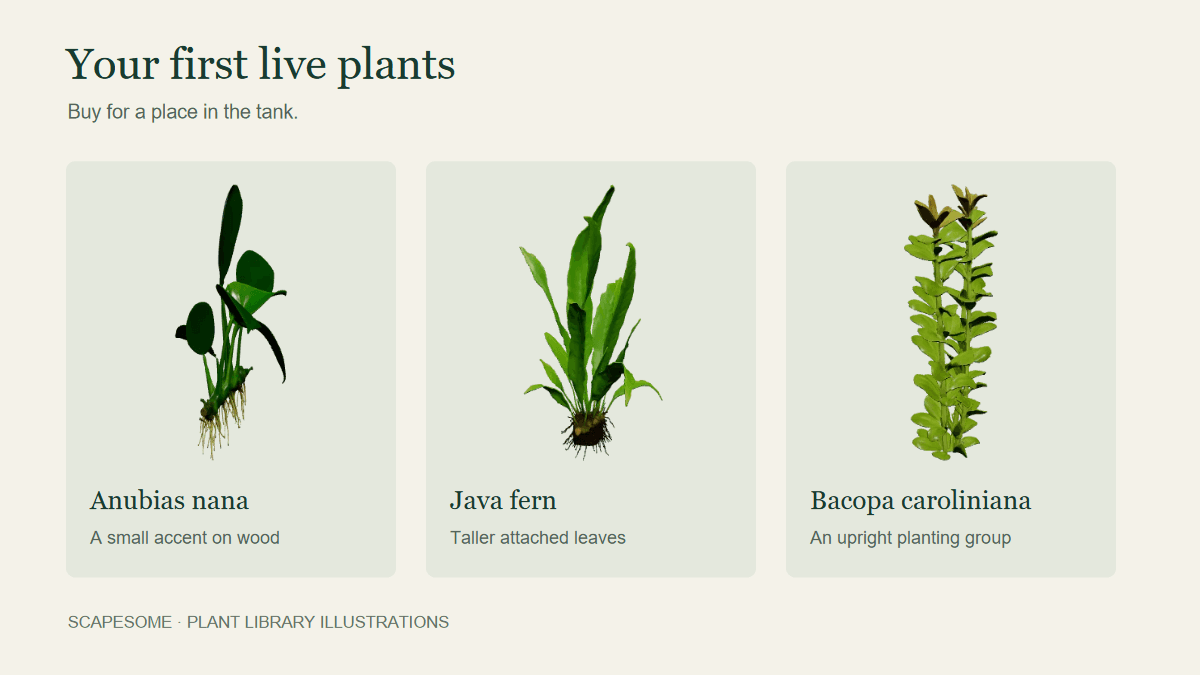
The best live aquarium plants for beginners fit a job in the tank: Anubias nana for a small piece of wood, Java fern for taller attached leaves, or Cryptocoryne wendtii for a planted patch. Add Bacopa caroliniana if you want an upright group you can trim. Java moss earns a place when you actually want to maintain a moss-covered surface.
Choose the jobs your tank needs. A mixed beginner bundle can leave you finding room for plants you never wanted; a smaller order with a place for each plant is easier to judge.
These are our picks for a first freshwater planted tank without injected CO₂, selected for planting flexibility, manageable care and a useful place in the scape. The aim is a short list you can buy and place with a reason for every item.
The shortlist: what each plant is best for
Plant | My reason to choose it | Where it goes | The catch |
|---|---|---|---|
Anubias barteri var. nana | Small, broad leaves on a modest piece of hardscape | Attached to wood or rock | Slow growth means empty space stays empty for a while |
Java fern | Taller leaves without building a rooted planting bed | Attached to hardscape | The variety and leaf length matter in a small tank |
Cryptocoryne wendtii | A rooted clump with a different shape from attached plants | In a suitable substrate | Allow for the whole rosette, and expect a possible transition after planting |
Bacopa caroliniana | An upright group you can shape and propagate | In the substrate, with usable light | It still needs trimming; a dark corner is a poor reason to buy it |
Java moss | A patch of fine texture on a surface you can reach | Secured in a thin layer to hardscape | Loose fragments and trapped debris create maintenance work |
Anubias gives a small piece of wood a low, broad-leaf accent. For an upright group at the back, I would choose Bacopa instead. Neither plant is a substitute for the other.
If you are still choosing between attached plants and a planted bed, the beginner guide by setup covers that earlier decision. Here, we will turn it into a first shopping list.
Check these three things before choosing a bundle
Will you keep the light you already own? A low-light label means a plant can cope with less light; it does not mean an unlit tank or a shaded corner is equally suitable. Look at the position where you want the plant, including what will be above it. Turning a light on for longer does not solve every problem with weak or uneven light.
Where will the plant feed and attach? A rhizome is the thick stem that links the leaves and roots of Anubias or Java fern. It stays exposed. A crown is the point where the leaves of a rooted rosette meet; its roots go into the bed while the crown stays at the surface. Those two planting jobs call for different spaces, even when both plants are sold in little pots. Easy plants still need an appropriate nutrient supply.
Who already lives in the tank? If fish regularly pull up decorations or eat soft leaves, choose with that behaviour in mind. Check the exact plant's temperature guidance against the tank you maintain. A healthy plant on a beginner list is still a poor purchase when its conditions or placement do not fit your particular aquarium.
Three small shopping lists to start from
You already have a tank with gravel and a piece of wood
Start with one healthy Anubias nana rhizome and one Java fern rhizome. By “one,” I mean a usable plant with its own growing section, not a promise that a shop's pot contains exactly one plant.
Give them separate attachment points. Place the Anubias where you want a low, broad-leaf accent. Put the fern where its taller leaves will have room to extend, rather than wedging both plants into the same gap. You can add live plants without replacing the existing floor.
Look for a firm rhizome and usable leaves. When planting, identify that thick horizontal stem and keep it exposed; its roots can hang down or grip the hardscape.
In the current Scapesome library, choosing Easy and Epiphyte narrows the list to attached-plant candidates. Anubias nana and Java fern appear together, with light and CO₂ guidance on their cards. Open the exact entry before buying: the filter is a starting point, and the image is a library illustration rather than the size of the specimen the seller will send.
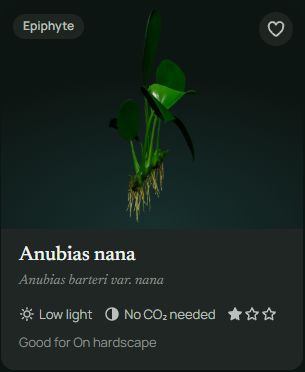
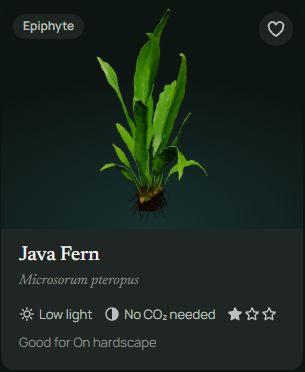
Two cards from the Easy + Epiphyte results, captured on 20 November 2026. Check the full name and care labels; these illustrations do not show retail package contents.
You want one rooted patch beside your hardscape
Choose Cryptocoryne wendtii plus one small attached plant. Ask the seller how many separately rooted rosettes the crypt package contains. A reasonable first plan is one planting group beside the wood, with Anubias attached above or beside it. Buying three pots because a photograph looks dense is a different decision from buying three usable plants.
The exact crypt variety matters. Tropica describes its Green form as a plant that can reach 10–30 cm high, with rosettes around 8–15 cm wide depending on conditions. That is enough to change the position you give it in a small aquarium. Treat “midground” as a suggestion relative to the tank, rather than a guaranteed height.
Plant roots in the bed and leave the crown at the surface. In plain sand or gravel, provide nutrients for that rooted group with an aquarium root-tab product used according to its directions. The guide to growing plants in sand covers this planting choice. You can keep the existing floor and feed the planting area.
A crypt can lose leaves after a move. If that would make you dig up a sound plant repeatedly, attached plants may be a more reassuring first purchase. With a crypt, assess new growth as well as the leaves it arrived with.
You want height at the back and do not mind trimming
Buy Bacopa caroliniana for one defined group, plus either Anubias or a crypt for a lower position. Ask how many sound, usable stems are supplied. “One bunch” does not tell you the number of stems you can actually plant.
Separate the stems rather than burying the retail bunch as a tight plug. Place the group where the lower leaves will receive light and where you can reach it with scissors. If the back corner is already shaded by a large piece of wood, resolve that first. A beginner label will not fix the shadow.
Bacopa is relatively undemanding and can be kept without injected CO₂, but it still needs usable light. Choose it for upright structure, and use healthy cuttings to expand a successful group later.
A 10-gallon check: move the fern before buying more crypts
I built this arrangement in Scapesome with a 50.8 × 25.4 × 30.5 cm tank, one piece of spider wood, one Anubias nana, one Java fern and one crypt group. The fern starts near the right side of the wood, beside the crypt. From the front, part of the brown crypt's left-hand outline disappears among the green fern leaves and wood.
These are deliberately chosen planning sizes, not a forecast of mature growth: the fern is 18 × 18.5 × 15 cm and the crypt group 15 × 12 × 15 cm, in length × height × depth. The small Anubias is 4.5 × 3 × 4.5 cm. Match the sizes to the material you expect to buy, then allow for growth. The generic crypt model here is not a measured specimen of Tropica's Green form.
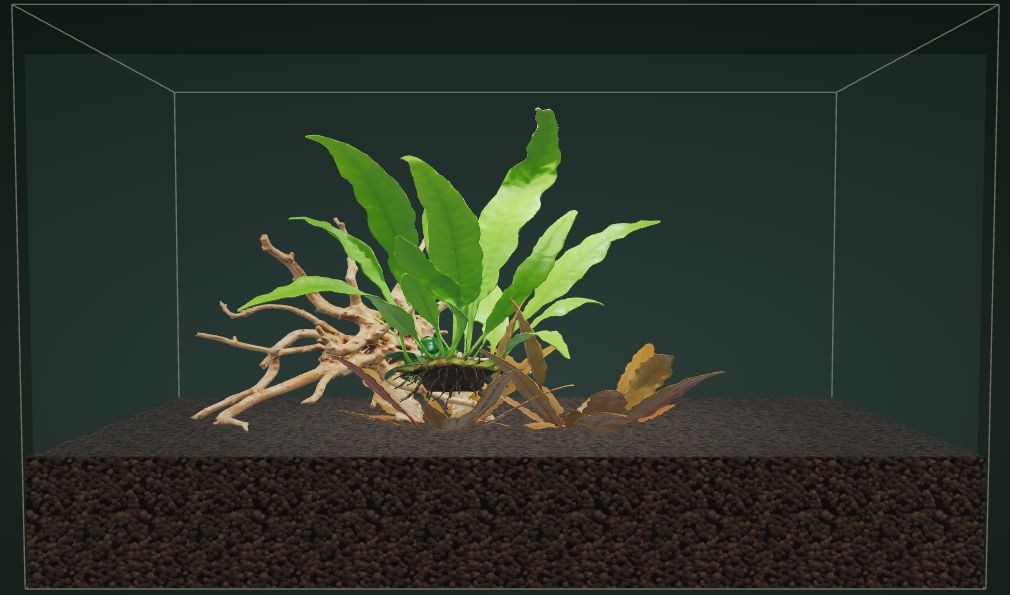
Before: the fern sits beside the crypt. Its leaves and the wood interrupt part of the crypt's outline. This is a real planning screen, not a photograph of a grown-in tank.
For the second arrangement, I moved only the fern to a left-hand attachment point on the same wood. The tank, other items, plant sizes and Front camera preset stayed the same. More of the crypt's outline is now visible. The little Anubias is easier to pick out, too. Neither plant needed to be enlarged or duplicated.
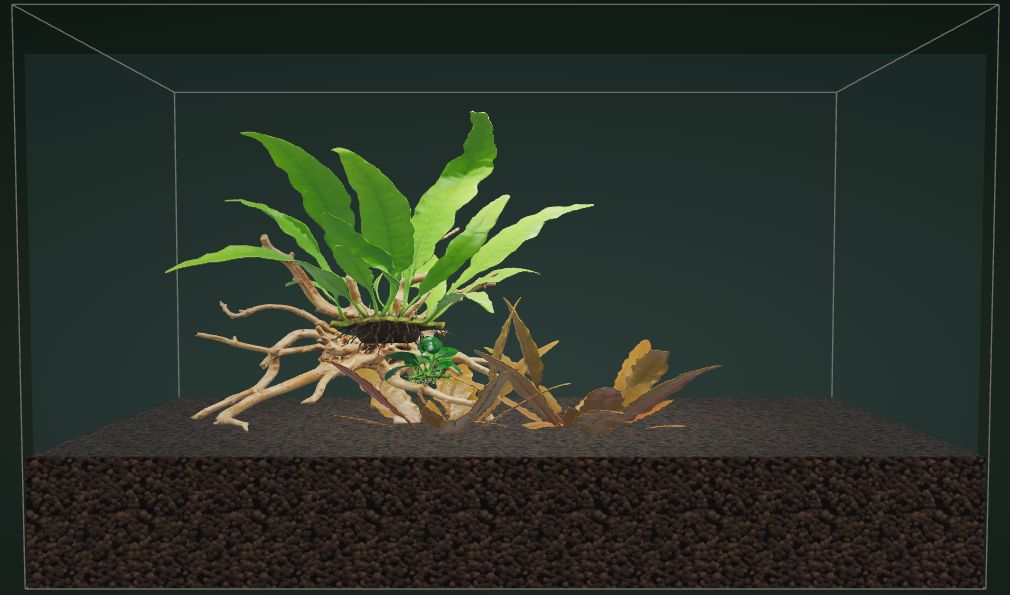
After: only the fern's attachment position changed. The crypt and Anubias are easier to distinguish; the order still contains the same three plant groups.
The top views add a useful check. The original fern spreads across much of the crypt's left side; after the move, more of the rooted group is exposed, although the plants still overlap. This is where I would pause the order: keep one planned crypt group and try the fern position first, rather than add a second crypt just to make the patch stand out. The floor still needs to suit your actual cleaning tools; the picture does not establish a measured clearance.
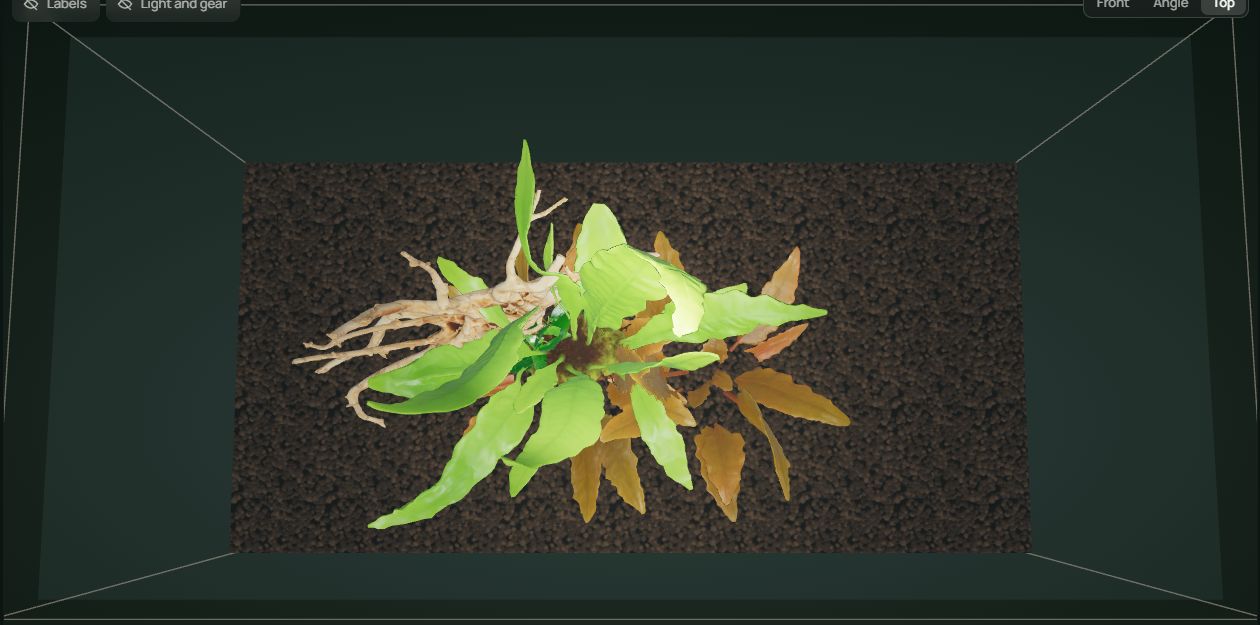
Top, before: the overlap is clearer from above than it was from the front.
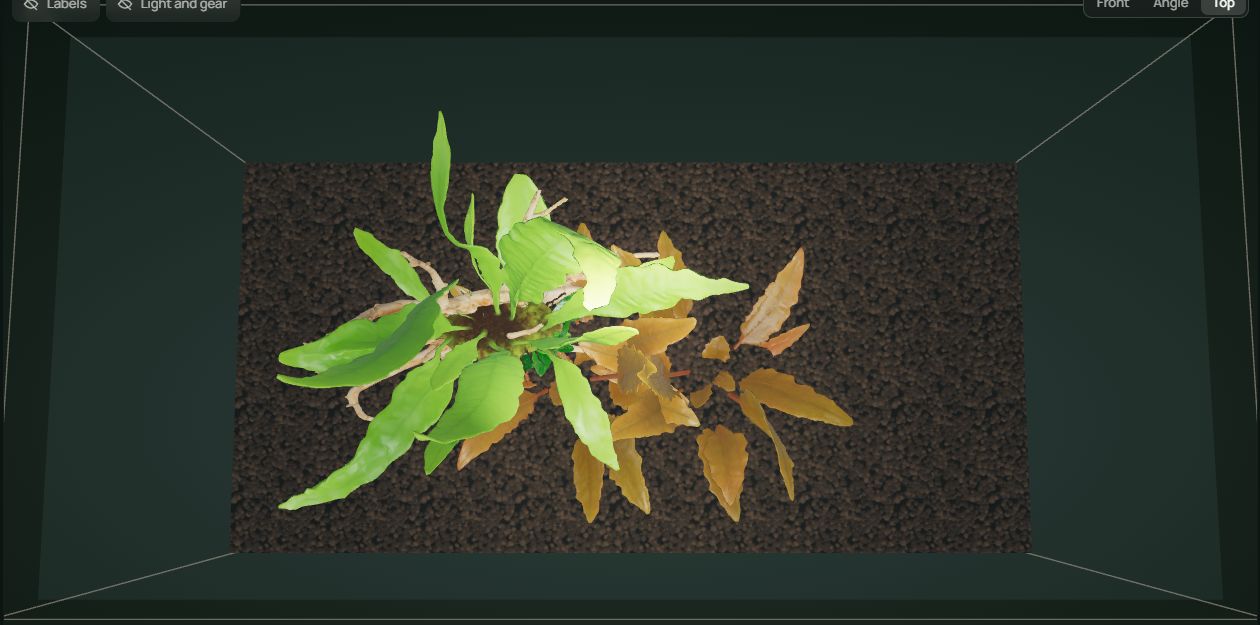
Top, after: more of the crypt is exposed. Some overlap remains, and the view alone does not prove a tool will fit.
To make your own comparison, open the plant library, check the exact entries, and use Scapesome's planner to place your choices by hand. Select your tank size, match the starting plant dimensions, compare Front and Top, then save a version before changing one item. I saved both arrangements and reopened them to check the sizes. The preview helps with placement; it does not measure light reaching a leaf or prove that a plant will thrive.
A pot, a bunch and a tissue-culture cup are different purchases
Before checking out, write the required material beside each planting job. For example: two independently usable rhizomes, one rooted group, or six usable stems. Those are shopping targets for a chosen arrangement, not standard contents of a retail package.
Then ask the seller what is supplied. A pot may contain several separable plants, one substantial specimen, or something much smaller than the product photograph suggests. A bunch is sold as stems, while a tissue-culture cup usually contains young material that needs preparation and division. Buying the same number of packages does not give the same starting appearance.
For a small first order, I would favour a clearly described specimen over an assortment with an impressive species count. Confirm the full plant name, the form supplied, its approximate size and how it should be prepared. Ask for a current photograph when the listing leaves those points unclear. The tissue culture versus potted plants guide explains that packaging choice in more detail.
Here is how I would write a small mixed order before translating it into packages:
Intended job | Material to ask about | What would change the order? |
|---|---|---|
One low accent on the wood | One healthy, independently usable Anubias nana plant | The supplied plant may already fill the intended accent; a second package would duplicate the job |
One rooted patch beside it | One suitable crypt rosette or a small separable group | The exact variety or supplied rosette is too large for the available patch |
One upright group at the back | A stated number of usable Bacopa stems | A bunch has fewer usable stems than expected, or the rear position is shaded |
Leave out any row your arrangement does not need. Translate usable plants or stems into packages only after checking the seller's stated contents.
For a worked example, suppose your chosen rear group needs six usable Bacopa stems, and a listing explicitly supplies three usable stems per bunch. Six divided by three gives two bunches. If the same listing supplies six usable stems per bunch, buy one. These are example inputs, not a standard bunch size. A listing that says only “one bunch” leaves the package count unknown until the seller supplies the missing number.
Good plants I would leave off this particular first order
I would leave an Amazon sword out of a small mixed order unless it has a deliberate place as a large specimen. A carpet needs its own planting and care plan. Neither belongs in the basket simply because a beginner bundle includes it.
Give a small order a fair start
Remove the packing material appropriate to the product, rinse away tissue-culture gel when that is what you bought, and keep the plants damp while arranging them. Follow the seller's preparation guidance.
Check position before treating every problem alike: expose a buried rhizome, secure a loose rooted plant, and reposition a stem group hidden behind wood. Those changes address different causes.
Take a photograph of the same view after planting. Look for new growth as well as changes to old leaves. Some leaf loss can follow a move, particularly with crypts; still check the plant's condition and placement. Remove loose decaying material without repeatedly uprooting a sound plant.
What I would put in the basket
Before paying, finish this sentence for each item: “I am buying this exact plant, in this supplied form, for this spot.” Leave out anything you cannot assign to a place.
Plant information checked in November 2026 for the 2027 guide.
Related reading
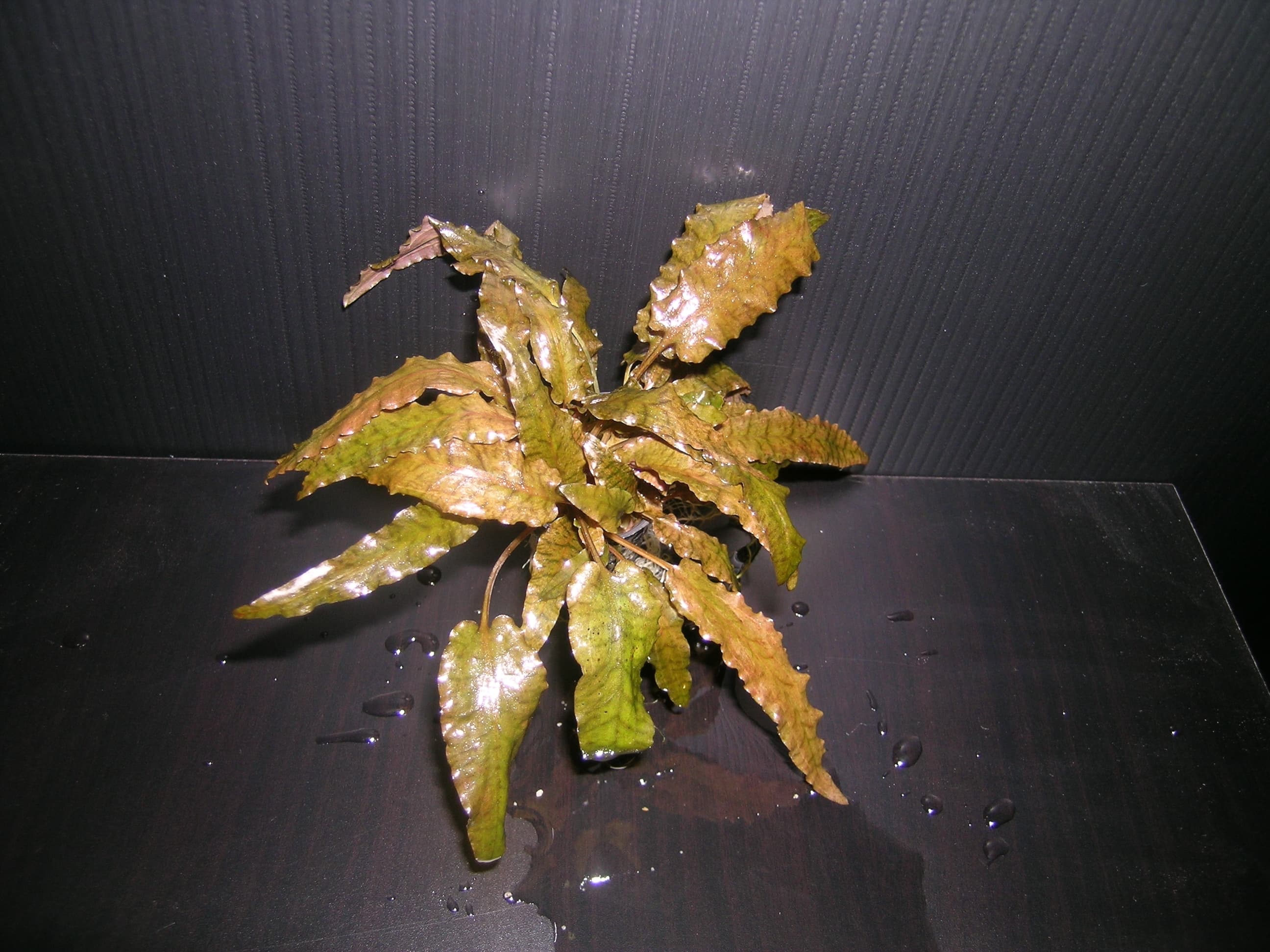
Crypt Melt: What to Remove, Check and Leave Settled
Check a melting crypt without repeatedly uprooting it. Use planting history, old and new leaves, and a simple photo record to guide the next step.
Java Moss vs Christmas Moss: Which Fits Your Tank?
Choose by light, the shape you want to maintain and the patch you can reach. Check the supplied plant before attaching it.
Carpet plants without CO2: which ones suit your tank?
Choose a foreground for a tank without CO2 injection: compare leaf shape, light, height and waiting time before you buy plants.