Volume to the rim
For a rectangular aquarium, multiply length × width × height in centimeters and divide by 1,000 to get liters. One US liquid gallon equals 3.785411784 liters. This tool uses US gallons, not Imperial gallons.
Use this aquarium volume calculator to estimate gallons, liters and water after substrate. Choose a standard tank or enter your own dimensions, then carry that setup into your scape.
How this estimate worksUse label dimensions for an estimate. For a closer measurement, use inside dimensions and your water height.
Even depth uses the same value at the front and back. Fractions such as 2 1/4 work too.
Choose a standard tank or enter length, width and height.
See how much water is left after substrate.
Estimate how much to buy for your depth.
Choose a preset above or compare the library’s dimensions below. Marketed capacity can differ from a rectangular volume calculation.
| Tank | Length (cm) | Width (cm) | Height (cm) |
|---|---|---|---|
| 2.5 Gallon | 30.5 | 15.2 | 20.3 |
| 5 Gallon | 40.6 | 20.3 | 25.4 |
| 10 Gallon | 50.8 | 25.4 | 30.5 |
| 15 Gallon | 61 | 30.5 | 30.5 |
| 20 Gallon High | 61 | 30.5 | 40.6 |
| 20 Gallon Long | 76.2 | 30.5 | 30.5 |
| 29 Gallon | 76.2 | 30.5 | 45.7 |
| 40 Gallon Breeder | 91.4 | 45.7 | 40.6 |
| 55 Gallon | 121.9 | 33 | 53.3 |
| 75 Gallon | 121.9 | 45.7 | 53.3 |
| 90 Gallon | 121.9 | 45.7 | 61 |
| 125 Gallon | 182.9 | 45.7 | 55.9 |
| 20C Cube | 20 | 20 | 20 |
| 30C Cube | 30 | 30 | 30 |
| 30F Shallow | 30 | 18 | 12 |
| 36P | 36 | 22 | 26 |
| 45P | 45 | 27 | 30 |
| 45F Shallow | 45 | 24 | 16 |
| 60P | 60 | 30 | 36 |
| 60F Shallow | 60 | 30 | 18 |
| 60H Tall | 60 | 30 | 45 |
| 75P | 75 | 45 | 45 |
| 90P | 90 | 45 | 45 |
| 120P | 120 | 45 | 45 |
| 180P | 180 | 60 | 60 |
| Fluval Spec V | 52 | 19 | 29 |
| Fluval Flex 9 | 34 | 33 | 33 |
| Fluval Flex 15 | 41 | 39 | 39 |
| Dennerle Nano Cube 30L | 30 | 30 | 35 |
| Dennerle Nano Cube 60L | 38 | 38 | 43 |
| Eheim Aquastyle 35 | 31 | 31 | 36 |
| Juwel Lido 120 | 61 | 41 | 58 |
| Juwel Rio 125 | 81 | 36 | 50 |
| Juwel Rio 180 | 101 | 41 | 50 |
For a rectangular aquarium, multiply length × width × height in centimeters and divide by 1,000 to get liters. One US liquid gallon equals 3.785411784 liters. This tool uses US gallons, not Imperial gallons.
The water estimate subtracts substrate volume from the rectangular volume, then reserves 8% for hardscape and space below the rim. This is a planning allowance; measure the actual fill if you need an exact water dose. Glass thickness, equipment, rocks and wood make the real amount different.
The result includes the volume of a simple even or sloped bed. To estimate the weight in pounds or kilograms, count bags and compare depths, use the dedicated aquarium substrate calculator. It uses the same formula and can carry your setup onward to a stocking check.
Water volume is one input to a stocking check. Take the same dimensions and substrate depths to the aquarium stocking calculator to estimate animal load against the water left after substrate, and to review group size, shared temperature and known conflicts for your fish, shrimp and snails.
Marketed capacity is nominal. A rectangular measurement may use exterior dimensions and does not account for the glass, rim, substrate or objects. The calculator displays measured rectangular volume separately from the estimated water you will have after the substrate.
Yes. Use a decimal, a fraction such as 1/2, or a mixed fraction such as 30 1/4. Switch units to see the same dimensions in centimeters. The underlying calculation keeps centimeters for consistency with the planner.
This calculator assumes a rectangular footprint and height. Curved glass, cylinders and irregular shapes need a different formula. Do not use a bounding rectangle as an exact capacity for those tanks.
Depth depends on the plants, material and slope. Depth fields start blank. Enter your intended depth, or choose Use a depth estimate after setting your tank dimensions. Try an example loads a sample setup only when you choose it. Check the substrate manufacturer’s instructions and the needs of your plants before buying.
The calculator answers a specific sizing question. In the aquarium planner, keep your own choices and place plants, rocks and wood by hand. Review light, CO₂, water conditions and substrate material before requesting an optional analysis.
Read how Scapesome checks a tank · Choose another aquarium calculator
Compare root capsules and two liquid formulas, then scale a stated label dose to a 51.3 L water estimate for a mixed planted aquarium.
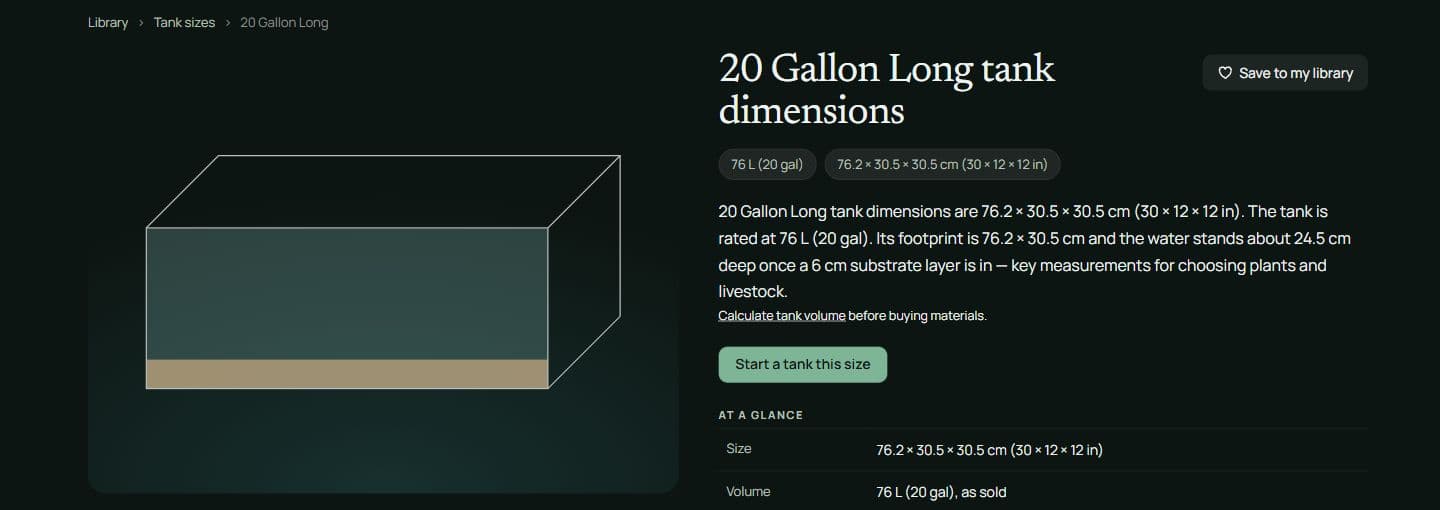
Same gallon label, different layout space. Compare length, height, substrate needs and access before choosing your tank.
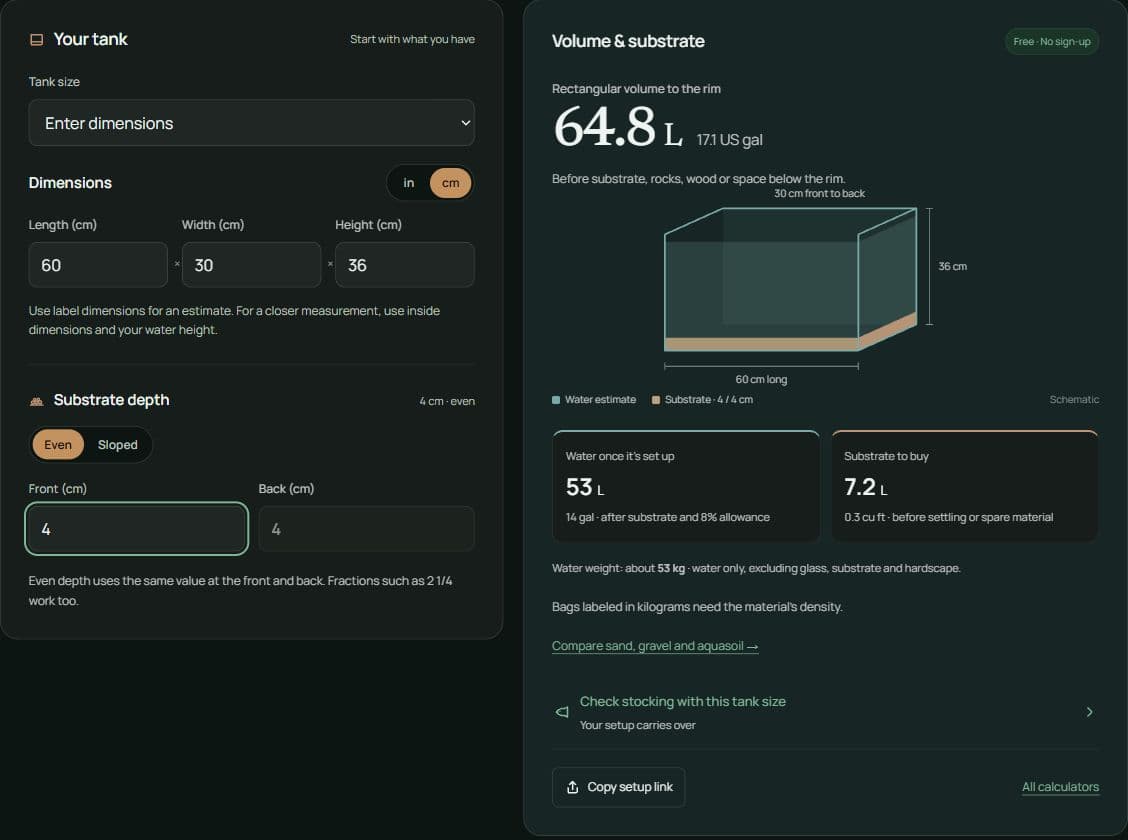
Work out which volume figure you need, understand the calculator’s allowance, and record the actual fill once your tank is built.